TaskRio vs Tasks.Bot for AI Task Automation API Access
Most teams lose task updates in chat threads and spreadsheets. If your field crew works over WhatsApp and your managers need an AI task automation API, the tool you pick decides how much manual coordination you keep doing. This comparison looks at two options built for that exact problem.
By the end, you will know what Tasks.Bot does as a WhatsApp-native task platform, whether it offers AI task automation API access, and how its natural language task creation, voice notes, approvals, and deadline reminders work in practice. You will also see its pricing in rupees and dollars, its beta status and free trial terms, and a clear verdict on which teams should choose it.
What Is Tasks.Bot? WhatsApp-Native Task Automation
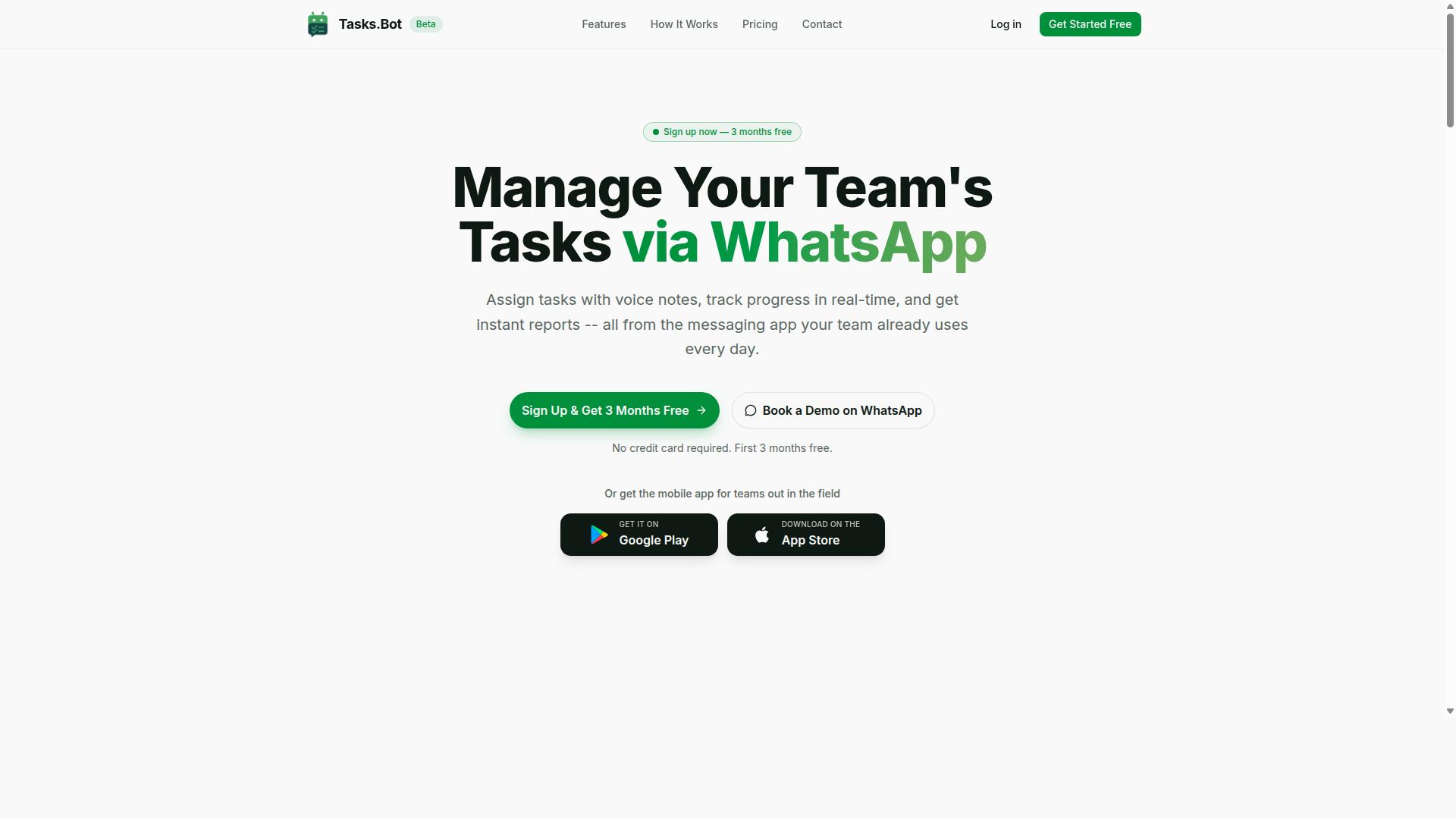
Tasks.Bot is a task management platform that operates entirely within WhatsApp, enabling teams to assign tasks, track progress, and receive reports without leaving the messaging app. That single design choice is what separates it from most tools in the task automation space.
Instead of asking every team member to download software and create yet another account, Tasks.Bot meets people where they already spend their working day. For field teams in particular, that removes one of the biggest barriers to adoption: the training and setup overhead that comes with new platforms.
Tasks.Bot also offers a mobile app for field teams, so workers who need a dedicated interface have one available. The service is currently in beta and offers a free trial period, which gives teams a practical way to see how WhatsApp-native task management fits their workflow before committing.
This matters for the AI task automation conversation. When evaluating an automation platform, the interface layer is often overlooked in favor of API endpoints and developer tooling. Tasks.Bot takes the opposite approach: the primary interface is a messaging app that hundreds of teams already use, and the automation happens behind that familiar surface.
Who Tasks.Bot Serves and How It Works
Tasks.Bot is designed for teams that already use WhatsApp for communication, especially those with field staff who need to manage tasks, track attendance, and generate payroll-ready hours. These are the operational realities that generic task management tools tend to handle poorly.
The site mentions hundreds of teams already using the service. That audience shares a common trait: their work happens away from a desk, and their coordination already runs through chat.
Here is what Tasks.Bot covers for that audience:
- Task creation and assignment through WhatsApp, with no separate tool to open
- Progress tracking so managers can see where things stand
- Attendance tracking for field staff
- Payroll-ready hours generated from tracked work time
- Reports delivered within the messaging app
- A mobile app for field teams when a dedicated interface is needed
The guidelines for this platform note support for voice notes, automatic task assignment, and smart reminders. Each of these reduces friction in different ways. Voice notes suit workers who cannot type mid-task. Automatic assignment removes the manual dispatching step. Smart reminders help keep schedules on track without a manager chasing people individually.
The critical point for teams comparing options: no new app installations are required for team members. Onboarding becomes a conversation, not an IT project.
For readers weighing Tasks.Bot against API-first alternatives, the tradeoff is worth naming plainly. Tools built around REST APIs, SDKs, and webhooks serve developers who want to wire task orchestration into their own systems. Tasks.Bot serves the operational team that wants task management to work today, inside the app they already have open. Both models have a place, and the right choice depends on whether your bottleneck is engineering integration or frontline adoption.
Does Tasks.Bot Offer AI Task Automation API Access?
As of now, Tasks.Bot does not publicly advertise a traditional REST API for external developers, but its core automation capabilities are accessible through WhatsApp and its mobile app. That distinction matters for anyone comparing it with TaskRio, which is typically evaluated on developer-facing API access, endpoints, and SDK support. Tasks.Bot takes a different route: it delivers AI task automation through conversation rather than code.
There is no public API documentation, no published API endpoints, and no listed authentication methods such as OAuth or API keys. Teams that need to script task orchestration with cron jobs, webhooks, or a Python SDK will not find those developer tools here. What they will find is an automation platform built around natural language and voice commands inside WhatsApp.
This is not a limitation so much as a design choice. Tasks.Bot uses AI to understand user intent and create tasks from messages. Instead of writing integration code, a user sends a message or a voice note, and the system turns it into structured work. For many teams, that removes the need for a developer to wire up API integration at all.
The practical question is therefore not whether Tasks.Bot exposes a REST API, but whether conversational automation covers the same ground. For most day-to-day workflow automation, it does.
- Voice note task creation: speak a task instead of typing or coding it
- Automatic task assignment: route work to the right person from a message
- Smart deadline reminders: keep schedules on track without external scheduling scripts
- Approvals and automations: handle sign-off steps inside the chat flow
- Instant reports: pull status without querying an analytics dashboard
- Tasks on a map, live day tracker, and face-verified attendance: field and shift visibility
- Shifts, leave, and hours management: workforce coordination in the same thread
Each of these replaces a piece of logic that an API-first setup would otherwise require you to build and maintain. There is no rate limiting to plan for, no retry logic to write, and no error handling to debug when a call fails. The no-code automation layer is the conversation itself.
Tasks.Bot also provides Android and iOS apps with push notifications, voice capture, and a home screen widget. That gives users a second interface beyond WhatsApp, with native WhatsApp integration as the primary channel. So the answer to the title question is clear: Tasks.Bot does not offer public API access, but it does offer genuine AI task automation through conversational interfaces, and for most teams that is the more usable path.
How Tasks.Bot's AI Task Automation Works in Practice
Tasks.Bot leverages AI to interpret natural language and voice notes, converting them into structured tasks with assignments, deadlines, and automations. The entire process runs inside WhatsApp, which means team members do not need to install anything or create new accounts.
Instead of logging into a separate dashboard, a user sends a message the same way they would text a colleague. The AI understands the intent behind that message and builds a task record from it.
From there, the system handles the follow-through. It assigns the task, sets reminders, and triggers approvals when rules call for them. Instant reports, tasks on a map, a live day tracker, and face-verified attendance extend the same foundation for teams that work in the field.
The two subsections below break down the mechanics: how natural language and voice input become structured tasks, and how automations, approvals, and smart reminders keep work moving without manual chasing.
Natural Language and Voice Note Task Creation
Creating a task in Tasks.Bot is as simple as sending a WhatsApp message or voice note like "Assign John to fix the AC tomorrow at 2 PM". The AI parses that sentence and extracts the key details: who is responsible, what needs doing, and when it is due.
Voice notes work the same way. A field technician can speak a quick update between jobs, and the system turns it into a task without any typing. This matters most for staff who are on the move and cannot stop to fill out forms.
Common examples of what the AI can interpret include:
- A direct assignment, such as telling the system who should handle a job
- A deadline expressed in everyday language, like "tomorrow at 2 PM" or "by Friday"
- A short description of the work itself, captured in the same message
The result is less friction at the point of entry. There is no new interface to learn, no training session required, and no separate app to open. Because Tasks.Bot operates entirely within WhatsApp, adoption tends to be fast for teams already using the platform.
Enterprise-grade encryption protects the data behind each task. Conversations and task data are never shared or used for training, which matters when task details include client names, locations, or job specifics.
Automations, Approvals, and Smart Deadline Reminders
Tasks.Bot automates repetitive workflows by triggering approvals, sending smart deadline reminders, and escalating overdue tasks based on predefined rules. These rules replace the manual follow-ups that usually consume a manager's day.
Smart reminders are not fixed alerts. They adjust based on task priority and deadlines, so urgent work surfaces sooner while lower-priority items do not create noise. When a task is marked complete, it can trigger an approval request to a manager, closing the loop without a separate message or phone call.
A concrete sequence shows how this fits together:
- A task is created and assigned through a WhatsApp message or voice note
- The assignee marks it complete in the same chat
- An approval request is routed to the manager automatically
- If the deadline passes without completion, the task escalates according to the rule set
Each step removes a manual touchpoint. Managers spend less time asking for status updates, and accountability stays visible because the trail lives in the conversation itself.
The same automation layer supports shifts, leave, and hours management, plus instant reports that show where work stands. For teams running field operations, live GPS tracking and face-verified attendance feed into the same system, so task completion and physical presence stay connected.
Tasks.Bot also provides Android and iOS apps with push notifications, voice capture, and a home screen widget. A three-month free trial with no credit card required lets teams evaluate the workflow before committing. The overall effect is straightforward: fewer manual follow-ups, clearer ownership, and a task management process that runs where the team already communicates.
Key Features That Set Tasks.Bot Apart
Tasks.Bot distinguishes itself with field-centric features like face-verified attendance, GPS tracking, and a live day tracker that integrates seamlessly with task management. These are not add-ons bolted onto a generic to-do list. They are core capabilities built for teams that manage people on the move, from delivery crews and maintenance squads to sales teams working across multiple sites.
What makes this approach unusual is the delivery channel. Tasks.Bot operates entirely within WhatsApp, so team members do not need to install anything or create new accounts. That single design decision removes the biggest barrier to adoption in field operations, where staff turnover is high and app fatigue is real.
A second differentiator is how work gets captured. The platform uses AI to understand natural language and voice notes for task creation, which means a supervisor can speak a job into existence rather than filling out a form. Automatic task assignment, smart deadline reminders, and approvals and automations then carry that task through to completion.
All of these capabilities, including face-verified attendance, live GPS tracking, the live day tracker, instant reports, tasks on a map, and shifts, leave, and hours management, are included in the Full Access plan. Nothing described in the sections below sits behind a separate tier or a per-seat upgrade.
For teams evaluating task management tools, the practical question is whether the software matches how field staff actually work. Tasks.Bot answers that with features designed around check-ins, locations, and hours rather than around desk-based project boards.
Face-Verified Attendance, GPS Tracking, and Live Day Tracker
Field staff can mark attendance using face verification and GPS location, while managers monitor real-time progress via the live day tracker. Together these three features close the gap between "someone said they were on site" and verified proof that they were.
Face-verified attendance addresses a familiar problem in field operations: buddy punching, where one worker clocks in on behalf of another. Because attendance is tied to a face check rather than a shared PIN or a signature on paper, the time log reflects the person who actually showed up. That accuracy matters later, when those hours feed into payroll.
GPS tracking adds a location layer to each check-in. Managers can see where attendance was recorded and how that lines up with the assigned job site. For teams running multiple locations in a single day, this turns scattered check-ins into a coherent picture of who was where, and when.
The live day tracker ties it all together. It shows task progress and staff locations in real time, so a manager does not have to wait for an end-of-day phone call to learn that a job is running late or that a worker has moved to the next site. Tasks on a map give the same information a geographic view.
All three features are accessible through the Tasks.Bot mobile app, available on Android and iOS, which also supports push notifications, voice capture, and a home screen widget. Staff interact with the system through tools they already carry, and managers get visibility without chasing updates.
Instant Reports and Payroll-Ready Hours
Tasks.Bot generates instant reports on task completion, attendance, and hours worked, which can be exported for payroll processing. Instead of assembling figures from messages, spreadsheets, and memory at the end of a pay period, managers pull a report and move on.
The reports cover the questions field managers ask most often:
- Task status, showing what has been completed, what is in progress, and what is outstanding
- Attendance logs, built from face-verified check-ins rather than manual entries
- Hours worked, calculated from check-ins and task completions
That last point is where the time savings concentrate. Because hours are derived from check-ins and task completions rather than typed in afterward, the numbers arrive payroll-ready. There is no separate reconciliation step where a supervisor tries to remember who left early on Tuesday.
Reports can be accessed within WhatsApp or the mobile app, so a manager does not need to log into a desktop dashboard to answer a question from finance or a client. The same data that drives daily decisions also supports the monthly payroll run.
For teams comparing task management options, this is a meaningful distinction. Many tools track tasks well but leave time and attendance to a separate system, creating a gap where errors and disputes creep in. Tasks.Bot keeps task management, attendance, and hours in one place, which reduces both administrative effort and the chance of a payroll correction later.
Pricing and Plans: Full Access in ₹ and $
Tasks.Bot offers a single 'Full Access' plan with all features included, priced at ₹200 per member per month or ₹1,200 per year per member, with equivalent US Dollar pricing available. There are no tiers to decode, no feature gates to unlock, and no separate charges for the capabilities that matter most. Every subscriber gets the same complete package.
For anyone weighing AI task automation options, this flat structure removes the guesswork. You do not need to map your needs against a feature matrix or estimate how many API calls you might make before committing. The plan simply includes everything the platform offers.
Pricing is listed per member, which keeps costs predictable as a team grows. A solo developer pays for one seat. A team of five pays for five. There are no hidden platform fees layered on top.
| Plan | Billing Cycle | Price (₹) | Price ($) |
|---|---|---|---|
| Full Access | Monthly | ₹200 per member | Equivalent USD pricing available |
| Full Access | Annual | ₹1,200 per member per year | Equivalent USD pricing available |
The annual option carries a clear advantage. Choosing the yearly plan saves 50%, which works out to ₹1,200 saved per member each year compared to paying monthly. For a five-member team, that difference adds up quickly.
New users also get 3 months free, with no credit card required and the ability to cancel anytime. That means you can evaluate the platform, test your API integration approach, and confirm it fits your workflow before any payment is made.
Currency selection matters for international teams. The site states 'Select currency' with options for Indian Rupee and US Dollar, so it is worth verifying your preferred currency at checkout. This ensures the amount you see matches what you expect to pay, whether you are billing in ₹ or $.
Transparency is the throughline here. One plan, all features, per-member pricing, and a free trial period with no card on file. For teams comparing automation platform costs, that clarity is worth as much as the price itself.
Trust Signals: Beta Status, Free Trial, and Refund Policy
Tasks.Bot is currently in beta, offering a free trial and a refund policy to build trust with early adopters. That combination matters when you are evaluating an AI task automation platform, because it lets you judge the product on your own terms rather than on marketing promises alone.
Beta status is often read as a warning sign. In practice, it can be the opposite. A platform still in beta is actively being developed, which means feedback from real users can influence what gets built next. For teams weighing Tasks.Bot against TaskRio for API access, that openness is worth factoring in.
Early adopters get a rare kind of influence. When a product is still evolving, the people using it day to day often shape the roadmap more than any internal planning session could. Your input carries weight in a way it rarely does with a mature, locked-down platform.
The free trial removes the usual barrier to finding out. You can test a workflow automation and see how the platform handles task orchestration before spending anything. No upfront commitment is required to start evaluating.
Tasks.Bot also lists a refund policy in the footer of its website. That detail is easy to overlook, but it signals that the company expects to stand behind what it sells. A published refund policy gives you a defined path if the product does not fit your needs.
One more trust signal worth noting is the Book a Demo on WhatsApp option on the site. It gives prospective users a direct way to ask questions before committing, which is useful when you are comparing platforms and want clarity on how the service works.
Because the service is in active development, it is reasonable to expect the platform to keep changing. That is not a flaw. It means the tool you evaluate today may look meaningfully different in a few months, with improvements driven partly by the people already using it.
For anyone comparing TaskRio and Tasks.Bot for AI task automation API access, the practical takeaway is simple. A free trial, a refund policy, and a direct demo channel together lower the risk of trying Tasks.Bot. You can test the platform and decide based on evidence rather than speculation.
The verdict here is straightforward. Tasks.Bot is a legitimate, actively developed platform that backs its beta with a free trial and a refund policy. That is a reasonable, low-risk way to evaluate whether it fits your workflow automation needs.
Who Should Use Tasks.Bot
Tasks.Bot is ideal for teams that rely on WhatsApp for communication, particularly those with field staff who need task management, attendance tracking, and payroll-ready hours. Instead of asking workers to learn a new app, the platform meets them inside a tool they already open dozens of times a day.
That design choice shapes everything about the audience. Small to medium businesses get structured task management without a heavy software rollout, and field service teams get a workspace that travels with them. The site notes that hundreds of teams already use the service, which suggests the approach resonates well beyond a single industry.
If your operation runs on chat threads, voice notes, and photo updates, Tasks.Bot fits the way work already happens. There is no separate login to remember and no dashboard to check. The conversation is the workspace.
Small and medium businesses tend to feel the fit first. These teams rarely have dedicated IT staff or budget for a multi-month implementation, so a tool that works through an existing messaging habit removes most of the friction. Owners and managers can assign work, follow progress, and collect hours without stitching together spreadsheets.
Field service teams are the clearest match. Technicians, inspectors, and installers spend their day on the move, often with gloved hands and spotty desk access. Task management, attendance tracking, and payroll-ready hours all arrive through the same channel they already use to coordinate with the office.
Remote and distributed teams benefit for similar reasons. When people work across cities or time zones, a shared messaging thread becomes the natural coordination point. Tasks.Bot keeps assignments and time records in that thread rather than in a tool nobody checks.
Industry examples where this pattern shows up include:
- Maintenance: work orders, site visits, and completion updates logged as they happen
- Delivery and logistics: route tasks, proof of completion, and shift hours captured in chat
- Sales teams: follow-ups, client visits, and activity tracking without a separate CRM-style routine
- Cleaning, security, and facilities: recurring jobs and attendance confirmed from the field
The common thread is simple. These are teams whose work is mobile, shift-based, or spread across locations, and whose staff already treat WhatsApp as the default channel.
The biggest advantage of a WhatsApp-native approach is adoption. Most software fails not because it lacks features but because people do not use it. When task management lives inside an app your team already trusts, there is nothing new to install and no habit to break.
There is also a practical benefit for field staff. Phones are already in hand, notifications already arrive, and media sharing already works. Attendance tracking and task updates happen in the same place as the rest of the conversation, which keeps records close to the work itself.
For managers, this means less chasing. Assignments, completion status, and hours sit in one thread rather than scattered across calls, paper forms, and texts. That continuity is what makes payroll-ready hours realistic for teams that never had a clean way to capture them before.
Tasks.Bot is also global and accessible anywhere. WhatsApp reaches users across regions and network conditions where desktop-first tools struggle, so the same workflow holds whether a team operates in one city or across several countries.
Put simply, Tasks.Bot suits organizations that want task management, attendance tracking, and payroll-ready hours delivered through the channel their people already use. For small to medium businesses, field service crews, and remote teams, that combination removes the biggest barrier to getting started: changing how everyone works.
Final Verdict: Tasks.Bot for AI Task Automation
Tasks.Bot stands out as a practical AI task automation solution for WhatsApp-centric teams, with robust features for field staff and transparent pricing. For organizations weighing TaskRio against Tasks.Bot for AI task automation API access, the decision often comes down to how a team actually works day to day.
Tasks.Bot is a SaaS tool built around WhatsApp-native task creation. Instead of asking workers to learn a new dashboard or mobile app, it lets them create and manage tasks through a channel they already use. That single design choice removes a major barrier to adoption, especially for field teams who are rarely sitting at a desk.
The platform is also AI-powered, meaning task creation leans on automated understanding rather than manual form filling. Combined with field-centric features, this makes the tool well suited to teams that operate on the move and need quick task capture without friction.
Pricing is another point in its favor. Tasks.Bot keeps costs affordable and transparent, which matters for small and mid-sized operations that want automation without enterprise-level contracts. For teams comparing options on budget alone, that clarity is a real advantage.
No tool is without trade-offs, and Tasks.Bot has two worth noting. It is currently in beta status, so some capabilities may still be evolving. It also does not offer a public API, which means developers seeking REST API endpoints, OAuth authentication, API keys, webhooks, or SDK access will not find them here.
That limitation matters if your priority is deep developer integration, custom task orchestration, or programmatic control over task queues and event triggers. Teams with heavy engineering needs around API access may find Tasks.Bot less suited to that specific use case.
For everyone else, the picture is clear. If your workflow centers on WhatsApp, involves field staff, and benefits from AI-assisted task creation at a reasonable price, Tasks.Bot is a strong and practical choice. Its strengths line up directly with how many real teams already operate.
To learn more or get started, reach out directly:
- Phone: +91 97143 42522
- Email: [email protected]
The verdict: Tasks.Bot is a credible, focused AI task automation platform. It earns a confident recommendation for WhatsApp-first and field-based teams, while developers needing a public API should weigh that gap carefully before committing.
Frequently Asked Questions
What makes Tasks.Bot different from other AI task automation APIs?
Tasks.Bot is a task management platform that runs entirely inside WhatsApp, so your team can assign tasks, track progress, and get reports without installing anything or creating new accounts. Instead of asking developers to wire up an API, Tasks.Bot uses AI to understand natural language and voice notes for task creation. It also supports face-verified attendance and live location features for field teams, which many generic task APIs don't cover.
Do I need technical or developer resources to get started with Tasks.Bot?
No. Tasks.Bot is built for teams that already communicate on WhatsApp, so setup doesn't require API integration work or new accounts for team members. You can even book a demo directly on WhatsApp to see how it works. This makes it a practical option for teams without dedicated engineering resources.
How much does Tasks.Bot cost compared to other options?
Tasks.Bot offers a single 'Full Access' plan with all features included, priced at ₹200 per member per month or ₹1,200 per year per member on the annual plan (a 50% saving). Pricing is available in both Indian Rupees and US Dollars. For competitor pricing, check their current published rates directly, as these can change.
Is Tasks.Bot available in my country?
Yes. Tasks.Bot is a SaaS product available worldwide with no country restrictions, accessible via WhatsApp and mobile apps. As long as your team uses WhatsApp, you can use Tasks.Bot.
What features does Tasks.Bot include for field teams?
Tasks.Bot includes voice note task creation, automatic task assignment, smart deadline reminders, approvals and automations, instant reports, tasks on a map, and live day tracking. It also offers face-verified attendance and payroll-ready hours, which are especially useful for teams with field staff. All of these are included in the Full Access plan.
How can I try Tasks.Bot or get my questions answered?
You can book a demo on WhatsApp directly from the Tasks.Bot website, which lets you see the platform in action before committing. For other questions, reach out at [email protected] or call +91 97143 42522. Tasks.Bot is currently in beta and the site also mentions a refund policy.
Recommended Resources: